> For the complete documentation index, see [llms.txt](https://docs.census.de/llms.txt). Markdown versions of documentation pages are available by appending `.md` to page URLs; this page is available as [Markdown](https://docs.census.de/navigating-and-searching/examples-of-typical-searches/find-records-related-to-a-specific-postclassical-work.md).
# Find Records Related to a Specific Postclassical Work
The easiest way to find Antique Monuments related to particular Postclassical Works is to search for the Postclassical Work are interested in, view it in Detail view, and then click on Relationships. There you will find all of the Antique Monuments, as well as Postclassical Works, related to the Postclassical Work in question.
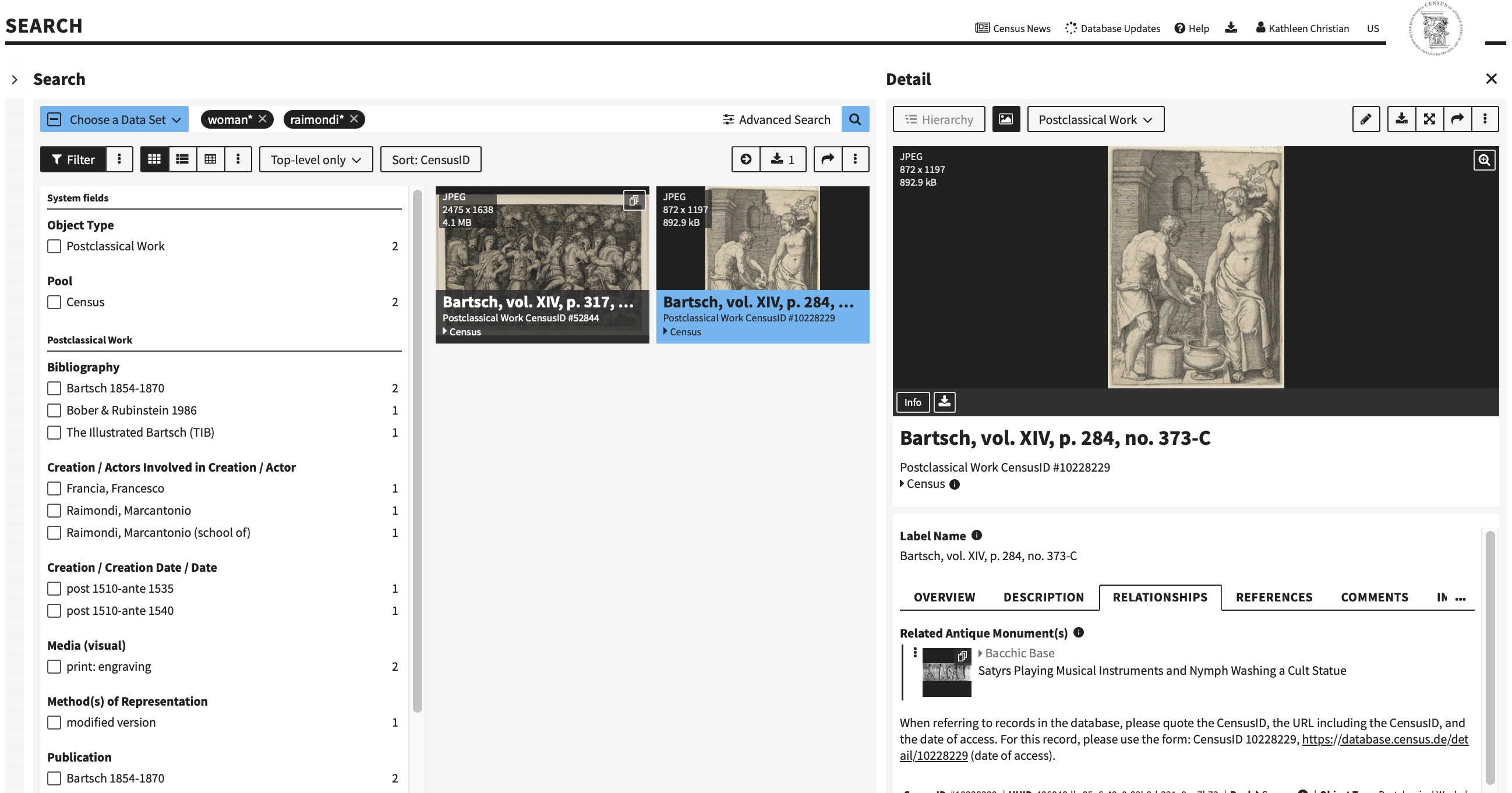
**As an example, to find the Antique Monuments related to Marcantonio Raimondi's *****Woman with Two Sponges*****:**
1. Find the work by Raimondi by typing words in the search bar, for example, Woman Raimondi.
2. Click on the print you are interested in, which opens up the record in the Detail view.
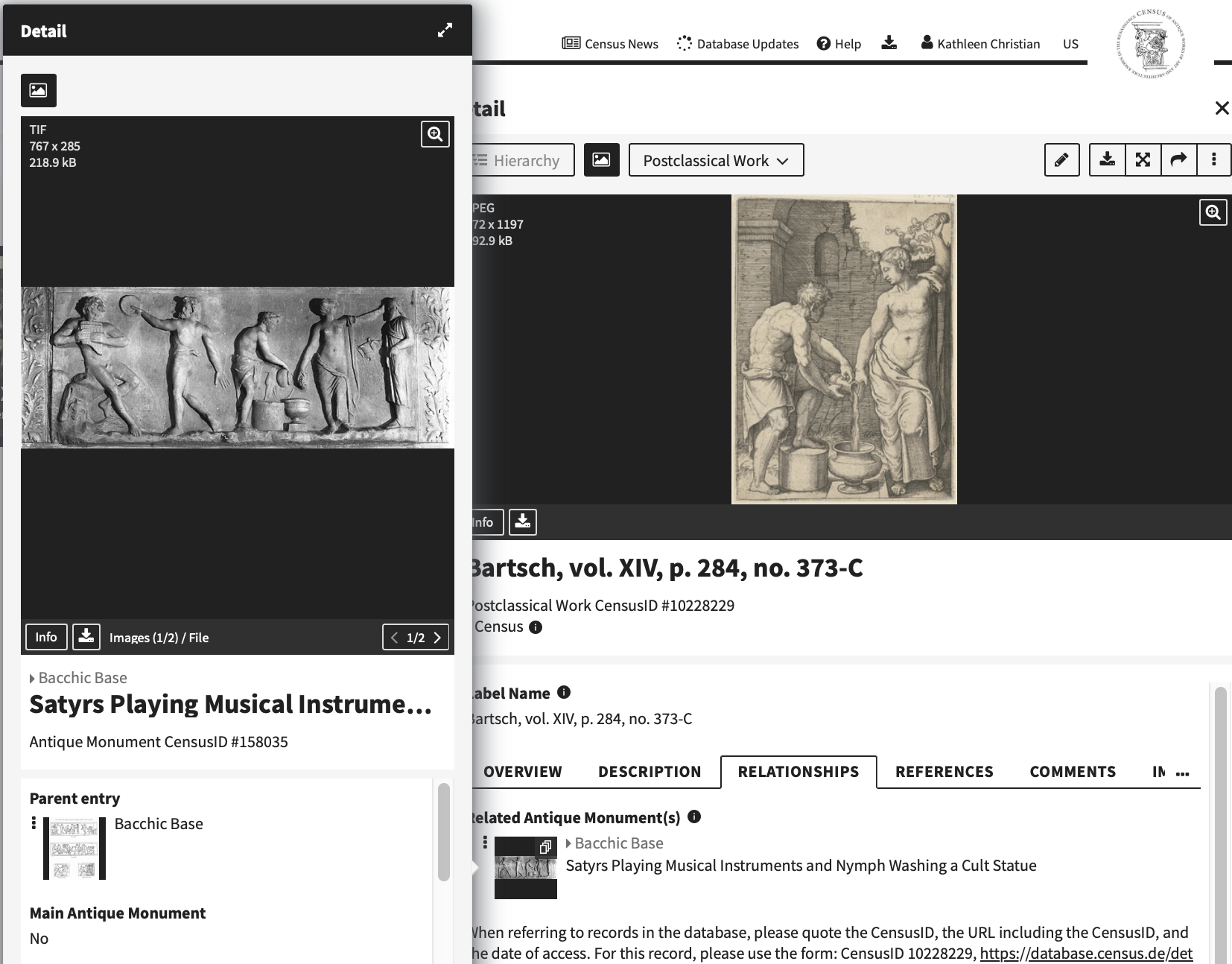
3. In the Detail view, find the tab 'Relationships'. Here you will see the Antique Monuments related to the print. In this case, you see a link to a relief of *Satyrs Playing Musical Instruments and a Nymph Washing a Herm of Bacchus* in the Villa Borghese.
You can access the related Antique Monument by clicking on the three-dots menu located next to the image preview. You can choose to view the full record of the related Antique Monument, or preview it using Quick view:
There are also other methods of conducting this same search. For example, you can also use this method for any Postclassical Work to find records which are linked to it:
1. Ensure that both 'Antique Monument' and 'Postclassical Work' are selected in the **Sources Menu** (accessed under 'Choose a Data Set'
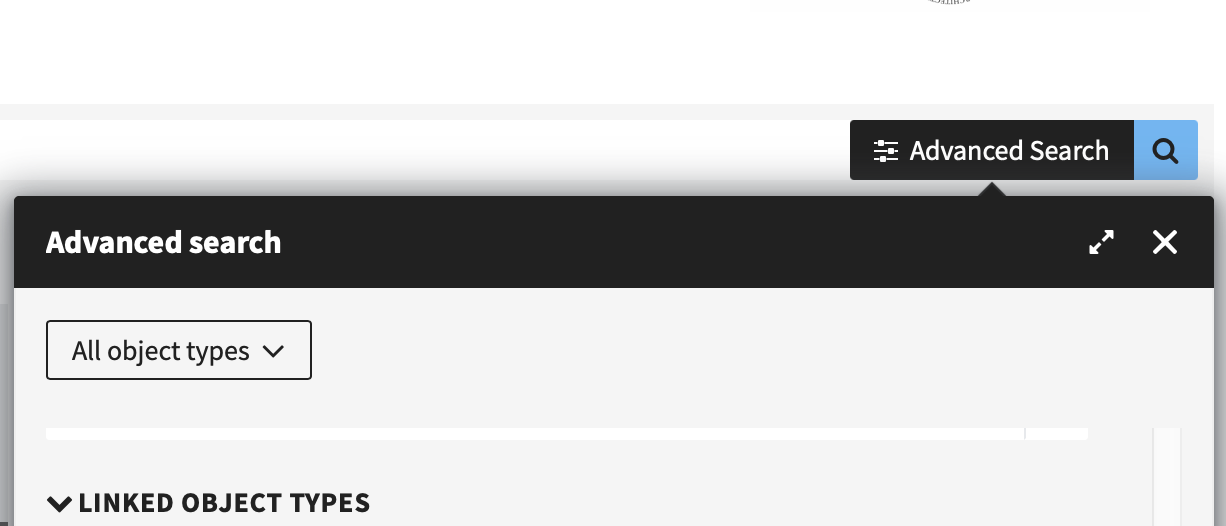
2. Open the **Advanced Search** window at the end of the search bar.
3. Select the option **All Object Types.**
4. Locate the menu for **Linked Object Types.**
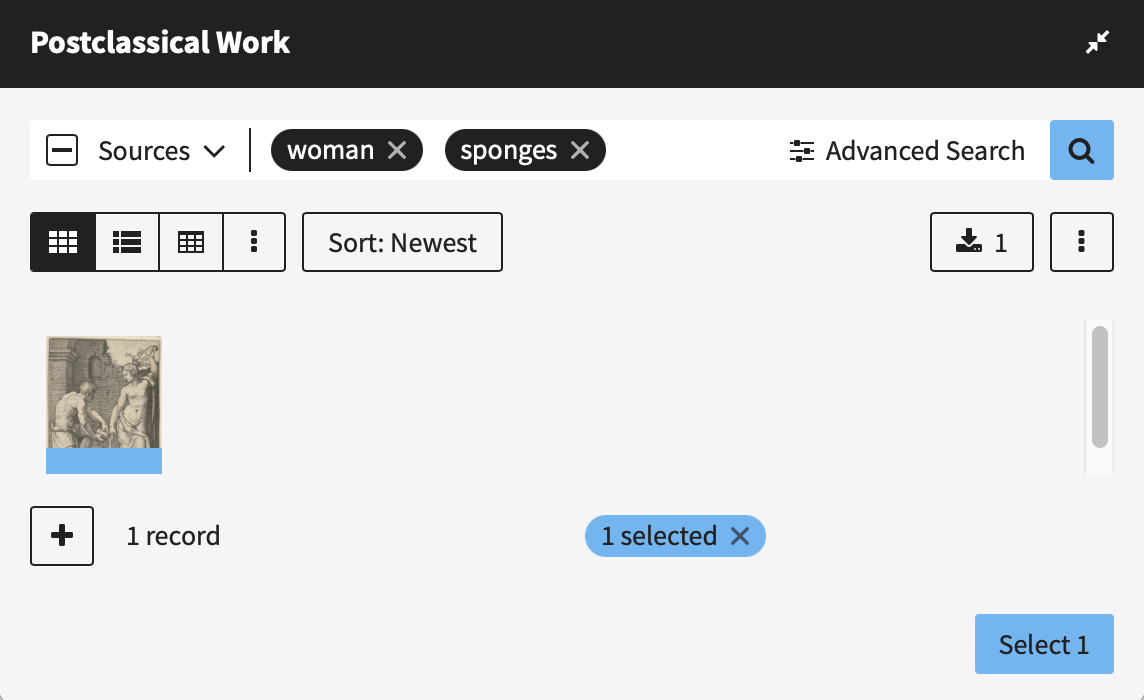
5. Scroll down to the field **Postclassical Work.**
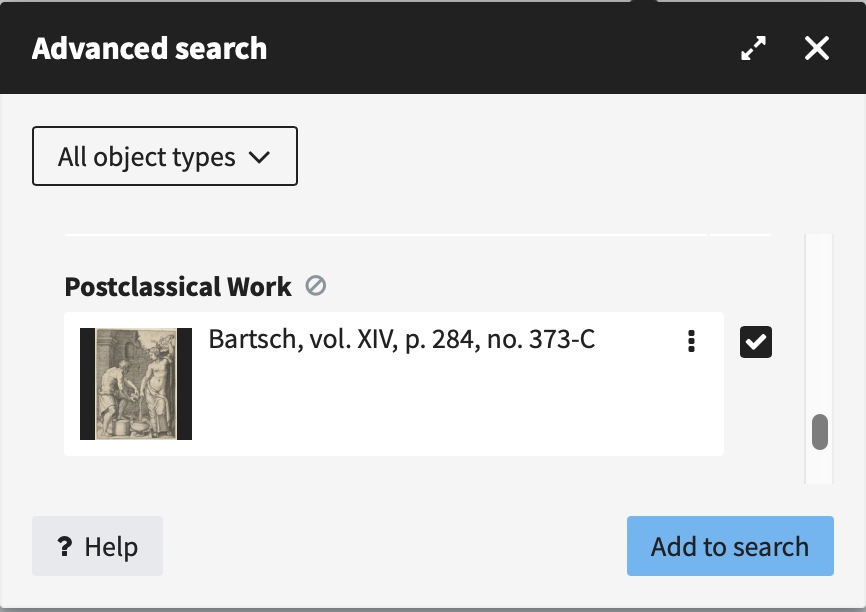
6. Now click on the line with three dots at the end of the field. A new window opens with a search field at the top. Search for the *Woman with Two Sponges.*
7. When you have found your object, choose it by clicking on it, then click on the button **Select 1** in the lower right corner of the window*.*
8. Now click on **Add to Search** in the Advanced search window.
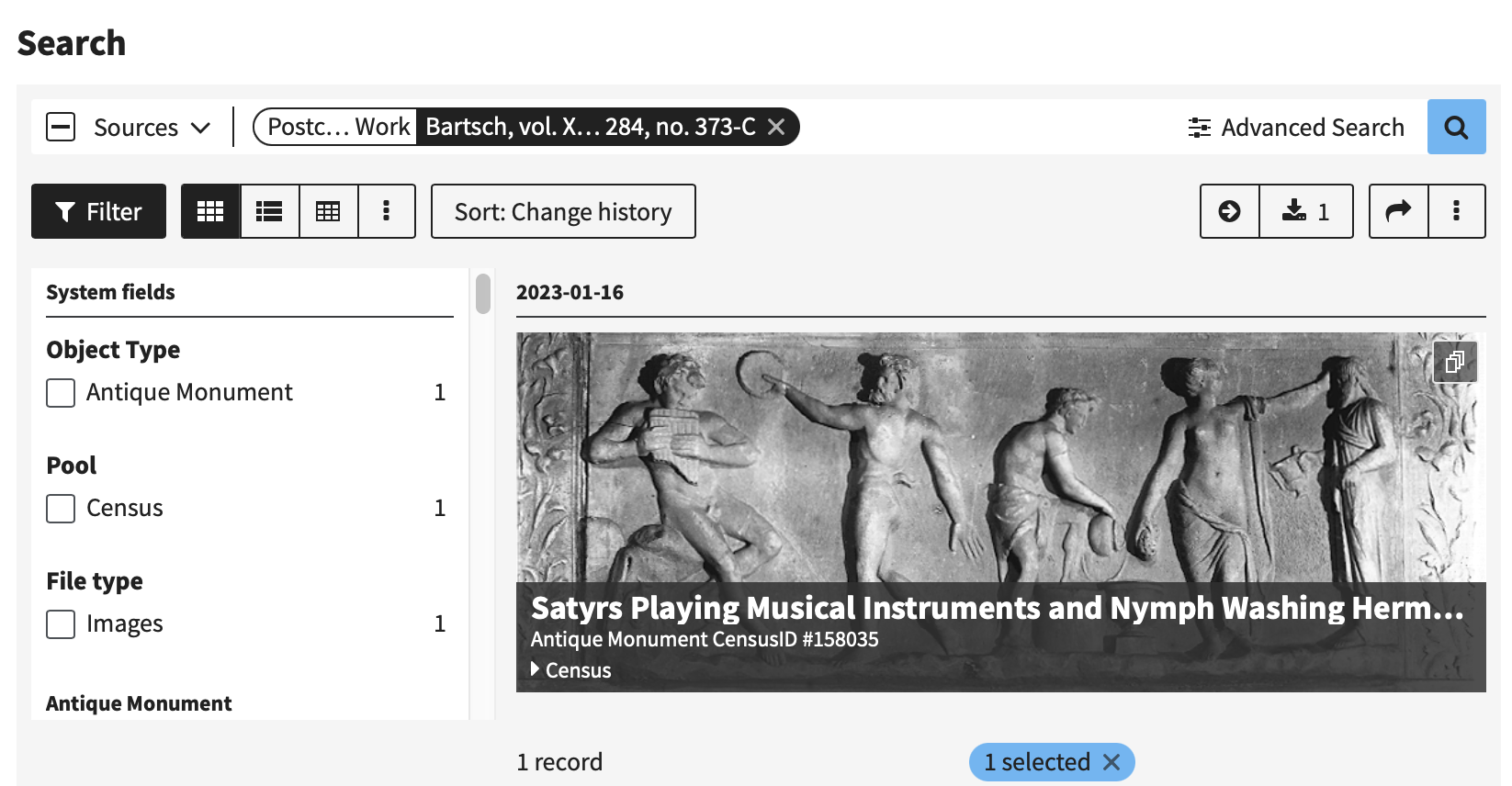
8. Now your search appears in the search field.
9. Hit ENTER to show the results. For this type of search, the results will usually consist of one Antique Monument, and in this case, it is a relief of *Satyrs Playing Musical Instruments and a Nymph Washing a Herm of Bacchus* in the Villa Borghese.